
Wheelchair Lift & Vertical Platform Lift Installation in Charlotte, NC
Charlotte Home Accessibility helps households find independent local pros for stair lifts, ramps, accessible bathrooms and wheelchair lifts, including vertical platform options for changing levels.
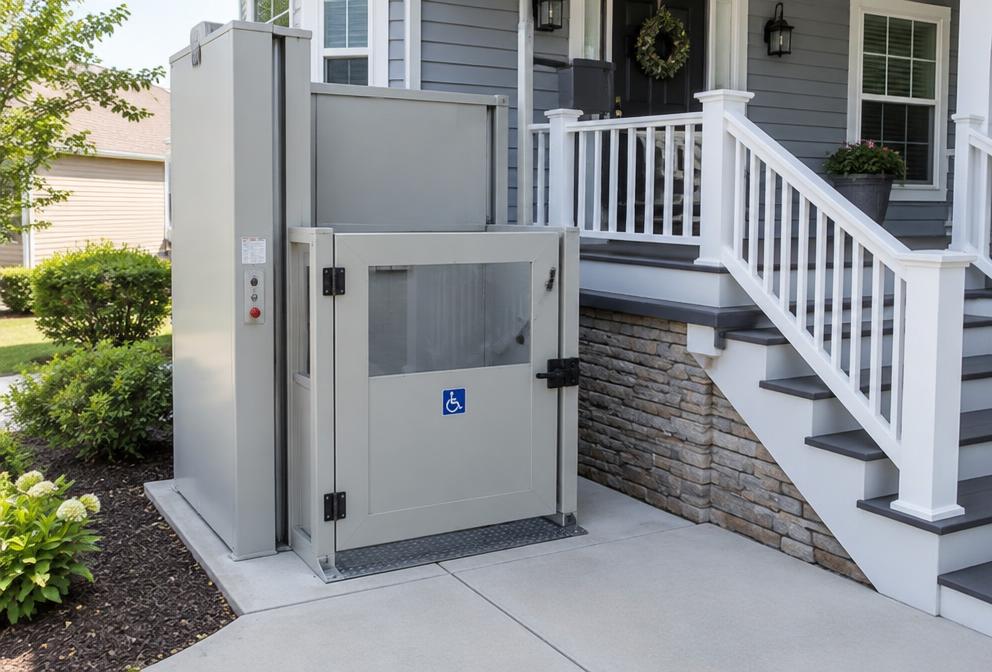
A short flight of porch steps can separate someone from a driveway, garden or family gathering. A vertical platform lift carries a wheelchair user on a level platform between landings, often using less horizontal space than a ramp. The right choice depends on travel height, equipment dimensions, available landing space and how the household would manage an outage.
Charlotte Home Accessibility introduces homeowners to independent providers rather than selling or installing equipment itself. A lift evaluation should include the whole arrival route: parking, the lower approach, gates, the upper landing and the door into the home. A compact lift will not solve an entrance that still leaves a chair stranded at a narrow threshold.
Match platform size and capacity to the rider
Some residential vertical platform lifts offer a 750 lb capacity, but capacities and platform dimensions vary by model. Count the combined weight of the rider, wheelchair and any permitted accompanying person or equipment. Confirm the manufacturer’s rules rather than assuming every lift can carry a caregiver alongside a powered chair.
Plan how the chair enters and exits
Straight-through and adjacent-entry arrangements need different maneuvering space. The provider should demonstrate gate swings, turning movements and control reach. A 60-inch turning circle is a useful planning reference where a full turn is needed, though the actual equipment and applicable requirements determine the design.
Build a stable base and a dry landing
A lift needs support designed for its loads and the manufacturer’s installation details. Existing pavers or a thin patio slab should not be assumed adequate. Review the foundation, anchorage, drainage and upper-landing attachment before ordering equipment, particularly where a porch edge or crawl-space foundation complicates the connection.
Outdoor protection matters in humid summers
Charlotte rain and humidity make drainage, corrosion resistance and weather-rated components important. Water should flow away from the base without creating a slippery approach. Ask about approved covers or enclosures, temperature limits and access for servicing rather than improvising a shelter after installation.
Review lift safety and local approvals early
Ask prospective installers how ANSI/ASME A18.1 applies to the proposed vertical platform lift and which local permits or inspections are required. Gates, interlocks, emergency stopping and controlled lowering should be explained in plain language. A battery feature may serve only a specific emergency function, not unrestricted operation during a power failure.
An HOA may need exterior drawings before a visible installation proceeds. Commercial settings and senior communities can have additional accessibility and inspection obligations. Get a site-specific review instead of treating a residential product brochure as proof that the entire installation satisfies applicable standards.
How a wheelchair & vertical platform lifts project typically goes
- Map the change in level. Record the entry height, preferred travel route and wheelchair dimensions. Discuss whether a ramp, platform lift or another entrance better supports independent use.
- Verify site and power needs. An independent provider assesses landing geometry, support, electrical requirements and weather exposure. Ask who coordinates any concrete, electrical or structural work.
- Review the equipment proposal. Compare rated load, usable platform area, gate arrangement, controls, warranty terms and service availability. Request clarity on permits and any items excluded from the installation quote.
- Practice operation and arrange upkeep. At handover, have the resident and caregiver practice entry, exit and emergency procedures. Keep the manual accessible and schedule maintenance at the manufacturer’s recommended intervals.
Materials, durability & upkeep
Exterior-rated platform surfaces
A stable, slip-resistant deck supports predictable transfers in changing weather. Verify that any surface treatment is approved for the lift and can be cleaned without damaging it.
Corrosion-resistant components
Appropriate coatings and fasteners help protect exposed equipment. Inspect damaged finishes promptly and follow the manufacturer’s instructions for cleaning and touch-up.
Engineered landing connections
Concrete, steel or framed landings must suit the specific installation. Their durability depends on correct support, drainage and connections, not simply on choosing a heavy material.
Wheelchair & Vertical Platform Lifts questions
Is a platform lift the same as a stair lift?
No. A stair lift typically carries a seated rider along a staircase, while a vertical platform lift can carry a wheelchair between levels without that seated transfer.
Will a lift work if the electricity goes out?
That depends on the model and its backup features. Ask which movements remain available, how emergency lowering works and what assistance the household should plan for.
Can an existing porch serve as the upper landing?
It may, after its structure, dimensions, guard arrangement and doorway approach are evaluated. Alterations can be necessary even when the porch appears spacious.
Not sure this is the right fit? Call us or send the form below and describe the situation — we’ll point you to the right kind of provider. Requests come in from across the metro, including Ballantyne, NC, Charlotte, NC, Concord, NC, Cornelius, NC, Fort Mill, SC and more.